Friends
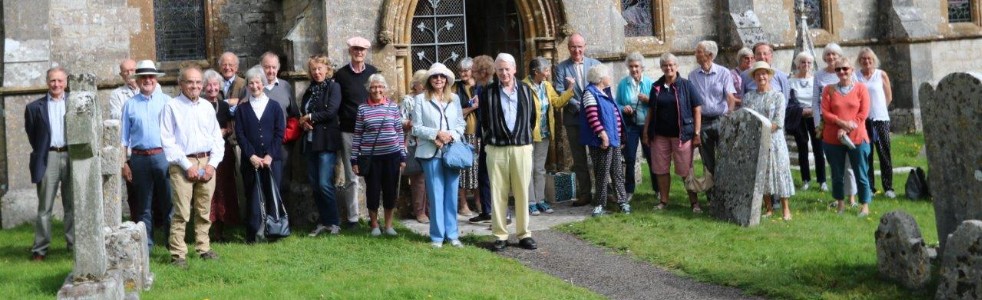
The Friends of DHCT are our core supporters. They further the aims of the Trust by donating an annual subscription which enables them to attend our various events, including our celebrated Church Crawls in the summer and Lecture Lunches in the winter. Our Friends help us to run our major fund raising event Ride + Stride and, over time, they become more closely involved by volunteering to be Parish Organisers, Deanery Area Representatives and even Trustees. Some very generously remember us by making a bequest in their Will. For a subscription of £20 (or more if you wish) or £30 for a couple, you can become involved in the work of DHCT.
If you wish to apply for membership and we hope that you will, please read our membership leaflet and then fill out our Word format forms. Please note that, while they open readily on a PC, they may be a bit trickier to open on a phone or tablet; this is a problem that we are not able to solve. Accordingly we recommend that you complete them on a desktop PC. Please take a look at the leaflet here . Click to download and complete the Friends' application form here and the Standing Order form here (revised Oct 2025) here
Should you be considering making bequest to the Trust through your Will, you will find our guidance on the process for adding a codicil or new clause to your Will here
Details of the fourth Crawl of the season on Monday 7 September are published below (posted Aug)
DHCT Church Crawls 2026: Monday 7 September 2026
Victorian Work to Medieval Churches:
10.30 am Arrive at Holy Rood, Wool, BH20 6DD
NGR: ST 84808650; /// meaning.limo.altering
Parking: DO NOT attempt to drive down Church Lane. There are only 2-3 disabled spaces by the church and it is a tight cul-de -sac. With care, you can park on the High Street, in the area of Colliers Lane, or in Colliers Lane itself. There are a few spaces outside Williams Bakery. Allow 10 mins to walk to the church from there.
Coffee and cake will, very kindly, be provided in the church.
Earliest elements of the church are C13, otherwise late medieval with C19 rebuild of chancel and south aisle by Hicks.
11.30 am Leave church to drive to St Christopher, Winfrith Newburgh, DT2 8HB
NGR: ST 80558435; /// rebel.feel.food
Parking: There are a few spaces outside the churchyard on the bend, and on the RH side on the East Chaldon Lane. Street parking is possible before you get to the church. Please conform to locals and park on one side of the street only. There is a lavatory in the church.
Medieval church of Norman origin with 1854 rebuild.
12.30 pm Drive to St Nicholas, Chaldon Herring, DT2 8DN
NGR: ST 79008315; /// levels.reclusive.brambles
Parking: There is a small car park on the RH side of the lane opposite the church (narrow entrance opposite stone building), careful street parking on approach. Again one side of the lane only.
Lunch - the church will be open for us to have a picnic lunch. We pass very few food shops on this crawl. Please buy any sandwiches etc. lunch enroute for to Wool. Regret that, being a Monday, the Sailor’s Return will not be open. Coffee and tea will be offered.
Present building of C14 origin, with C15 alterations, substantial rebuilding in 1878 by Crickmay.
2.00 pm Drive to Holy Trinity, Warmwell, DT2 8HQ
NGR: ST 7535 8580; /// stitch.drive.static
Parking There are two entrances to the church, pass the first one (just off the roundabout) and park in the yard adjacent to Warmwell Saddlery/stables on LH side, opposite the lower path to the church.
Current building C13 in origin, Victorian chancel of 1881 by RC Bennett of Weymouth.
We are very grateful to Dr Tim Connor who will be guiding us round the churches.
Facilities:
Lavatories: Wool, Winfrith
• Please check with your own maps before setting off for the day.
• Do bring some money with you for donations into the church boxes and the refreshments.
As usual please share transport if you can since car parking is very limited at the churches.
Booking and Paying:
The numbers for this DHCT Church Crawl are limited. Places must be booked and paid for (£10 per person) in advance please by 6.pm on Friday 28 August 2026.
Payment should be made online please to Dorset Historic Churches Trust, Sort code 30-92-69 account number 00412179. Ref: crawl September 2026
If you are absolutely unable to pay online, please send a cheque payable to Dorset Historic Churches Trust, to Mr Tim Smith to arrive by Friday 28 August 2026.
Book your place by email to [email protected] saying you have paid and are attending. Please note I am on holiday and out of the country between 24 August -5 September. I anticipate being able to see my emails, but may not be in a position to respond. Early booking would therefore be much appreciated on this occasion.
DHCT Church Crawls 2026 Crawl No. 3 visited Blandford Forest on 30 July:
Winterborne Whitechurch, Winterborne Stickland, Shillingstone and Okeford Fitzpaine
St Mary, Winterborne Whitechurch, Medieval flint church with early C13 chancel, central tower, nave rebuilt C19.
St Mary, Winterborne Stickland,
C13 flint church with C18 remodelling of the nave.
Holy Rood, Shillingstone
Lunch -
Shillingstone Church Visit Medieval church with Nave and chancel of Norman origin and Perp Ashlar-faced west tower. C19 North aisle, Decorated roof by Bodley.
St Andrew, Okeford Fitzpaine
Late medieval church with C15 west tower, C19 chancel and other alterations.
We are very grateful to Dr Tim Connor who will be guiding us round the churches.
Facilities:
Coffee beforehand: Winterborne Whitechurch
Lunch: Shillingstone Church Centre for picnic/ co-op for sandwiches/Willow Tearooms ( latter needs pre-booking)
Tea Okeford Fitzpaine
Second Crawl of the 2026 season took place on Wednesday 17th June
Kindly arranged by DHCT Friend Mr Graham Luker, the outline of our visit is below:
1. Skinner Street United Reformed Church . BH15 1RQ.
In addition to Dr Tim Connor’s talk, historical documents and photos will be available to view.
2. St Joseph & St Walburga RC Church BH14 9AZ
Interior has outstanding modern stained glass.
3. Church of The Transfiguration, Chaddesley Glen, Canford Cliffs BH13 7PF.
Lunch in the hall or church grounds. Picnic lunch recommended.
4. St Ambrose Church Westbourne BH4 8BE
Talk by Alwyn Ladell, local historian. Documents/photos to view.
First Crawl of the 2026 season was on Tuesday 19 May and is summarised below
Batcombe, Melbury Bubb, Evershot, Melbury Sampford
This is a fine late medieval country church in a beautiful location. The tower will be open for those who wish to climb to see the spectacular view.
11.30 am Drive to St Mary, Melbury Bubb (ST 59700660). Small late medieval church with fine west tower, Victorian restoration and unique Anglo-Saxon font.
12.15 pm Drive to Evershot (ST57250445). Lunch: Bring a picnic. The Acorn Inn does not serve food on Tuesdays, but is open for drinks.
1.30 pm St Osmond, Evershot, Late medieval with Victorian restoration.
2.00- 2.30 pm Drive to St Mary, Melbury Sampford (ST 57750595) privately owned; we visit by kind permission of Ilchester Estates. Late medieval with Victorian work. Re-set medieval glass and exceptionally fine monuments. Parking in front of the house.
Dr Tim Connor guided us round the churches.
Lecture Lunches in 2026
The second Lecture Lunch was on Thursday 23 April, again at the Langton Arms in Tarrant Monkton. Our Speaker will be Dr Tim Connor who chose to describe the life, work and influence of a truly remarkable 15th century wood carver and sculptor "Tilman Riemenschneider"
The first Lecture Lunch was held on Wednesday 18th March at the Langton Arms in Tarrant Monkton. Our speaker was Anne Gwatkin who gave us a fascinating account of the role of the Benedictines in England from before the Norman Conquest until well after the Dissolution of the Monasteries entitled "The Legacy of the Monasteries in Dorset" or "What have the Benedictines ever done for us?" At one time, the Benedictines owned about 40% of the land in England and, with their great wealth, were able to build and decorate on a grand scale. Their legacy can be seen in churches all over the County. 40 Friends and their guests found the talk absorbing; they then enjoyed further discussion over the traditional Langton Arms lunch.
Later Crawls 2026
For your diaries, here is the provisional programme for our Crawls this summer.
1. Blackmore Vale - Tuesday 19 May - details above.
Melbury Bubb
Batcombe
Evershot ( lunch)
Melbury Sampford
2. Poole - Wednesday 17 June
Skinner Street URC
St Joseph and St Walburga Roman Catholic church
The Church of the Transfiguration, Canford Cliffs
St Ambrose Westbourne
3. Blandford Forest - Thursday 30 July
Winterborne Whitechurch
Turnworth
Shillingstone ( lunch)
Okeford Fitzpaine
4. Purbeck – Monday 7 September
Wool – Holy Rood
Winfrith Newburgh
Chaldon Herring (lunch)
Warmwell
We will let you know when details are available and bidding for places is open but please also watch this website. For practical reasons, the numbers for all DHCT Church Crawls are limited and places must be booked and paid for (£10 per person) in advance please.
DHCT Lecture Lunches that took place in 2025 - a flavour
Lecture Lunch 1 took place on Thursday 27th February 2025. It was held at The Langton Arms, Tarrant Monkton, Blandford Forum. After gathering for coffee our speaker, Dr Tim Connor, gave an illustrated and very interesting talk on “Churches after a Fire: London, 1666 – 1720”. This really showed the constraints that the churches has that we have not experienced in Dorset. Lunch was served after the talk and the meeting finished about 2pm.
Lecture Lunch 2 took place on Wednesday 19th March 2025 again at the Langton Arms, Tarrant Monkton. After coffee Sue Bruce-Payne spoke about “Music through the Ages”. This again was a very interesting talk and was not only illustrated but we had the sound system working to demonstrate the particular instruments and arrangements she discussed. Following the talk we had lunch and finished in the early afternoon.
Discovering the Natural World in Stained Glass 13 March by Sue Smith
Over 40 members of the Friends of DHCT welcomed well-known decorative arts lecturer Sue Smith to talk about the presentation of the natural world in stained glass. Using a selection of delightful images to illustrate the possibilities of this medium and this subject, Sue emphasized the remarkable range of imagination, skill and creativity employed by artists and crafts people through the centuries.
From the fourteenth century onward, starting with “silver stain” techniques, representations of the kinds of plants and creatures people saw all around them appeared in stained glass windows. By the seventeenth century, heraldic devices became more often used and enamel painting allowed more naturalistic style of presentation.
Glass makers used birds, animals and plants purely for their beauty but also as the traditional accompaniments to saints and allegorical figures. Commissioners of windows in civic buildings and private homes as well as churches, also used the natural world to create pleasant associations with themselves, such as owls representing wisdom or lions fierceness.
The lecture ranged throughout the British Isles, but also featured some local examples of beautiful work, including in churches at St George’s, Dorchester, Middle Woodford and Alton Pancras. After the lecture, a number of questions were asked, and thanks given by the organiser Tim Smith. The staff of the Langton Arms then served a delicious hot lunch.
DHCT Past Events
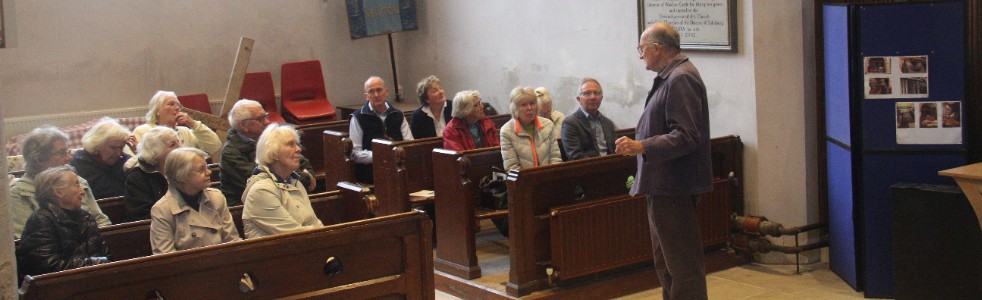
40 Friends of Dorset Historic Churches Trust gathered for their annual meeting in the beautiful setting of St Mary's church. St Mary’s is full of interest, especially for its stained glass, which was the subject of an absorbing talk by local resident and researcher Sarah Sexton, who is nearing the completion of a book on the windows at St Mary’s. She revealed a considerable depth of information about the origins and designs of the glass, especially the Harry Clarke window, installed in memory of Roma Spencer Smith. This is nationally admired, and described as “awe-inspiring” and “rare and exceptional”. Members were able to move round the building and get good, close-up views of all the windows discussed.
Contrasting interest was provided by St Mary’s Director of Music, Sir Peter Newson-Smith, who entertained the Friends with an organ recital of works from the seventeenth century to the present time. This was very successful in showing off the capabilities of the instrument, which seems ideally suited to accompanying services in the church.
After an excellent buffet lunch in the church hall catered for by Dorset Delights, Dr Tim Connor, the Trust’s architectural historian, revealed the fruit of his researches at the Dorset History Centre into the life of Sir Owen Morshead, who founded the DHCT in 1960. Sir Owen retired to Sturminster Newton and, as members gathered round his memorial plaque in the church, Dr Connor reviewed his highly decorated military career in the First World War, his work as Librarian at Windsor Castle and his involvement in the growing movement to preserve building of historic importance in the mid twentieth century. As the first Chairman of the Trust, Sir Owen served until 1971, seeing DHCT on its path to becoming the successful conservation charity it is now.
At the end of the day, Hon Sec Jeremy Selfe, deputising for the current chairman, thanked the speakers, the organist, the caterers, Dorset Delights, and especially the organisers Mike Warren and Tim Smith.
The Event concluded the Friends activities for 2023 but a new programme of Lecture Lunches in March and April and Church Crawls later in the year is being planned for 2024. Keep an eye on the website for details as they become available.
Lecture Lunches in 2023
The first Lecture Lunch took place on Wed 15 Feb 2023 at the Langton Arms, Tarrant Monkton, DT11 8RX. Dr Tim Connor, who is the Trust's expert historian and specialist on architecture, chose “The Gothic Revival” as his topic. After the very well-received talk, a delicious and filling lunch was provided by staff of the Langton Arms, with drinks available from the bar.
On Wed 15 Mar, The Reverend Canon Eric Woods DL, formerly the Vicar of Sherborne and DHCT Trustee, talked on “The Reformation of the Landscape”. We met at 10.30 at The Old Milking Parlour at Cavokay House, Marsh Lane, Henstridge, Somerset, BA8 0TQ. After the talk which explained how the lands released from the monasteries were keenly bought up by a rising class of successful merchants and lawyers who then became a new class of Landed Gentry. About 25 Friends sat down to delicious lunch and further discussion about Canon Woods' stimulating and scholarly talk.
Church Crawls in 2023
Our season of conducted visits to churches of interest, known as Crawls, started on Thu 11 May at Compton Valence. The report is below:
Back on the road for the summer 2023 programme of Church Crawls, over 40 Friends met at Compton Valence where, after a welcome from organizer Sue Bruce-Payne, and very welcome refreshments arranged by the local team, Dr Tim Connor spoke warmly about the early 19th century church. He was able to point out much of the architectural detailing – inside and out – incorporated by the designers, who were a group of young high churchmen with the enthusiasm and money to create this rural gem.
Moving on to Chilcombe, the archetypal church in a farmyard, we saw the kind of simple, tiny building that would have been common in the early Middle Ages. Beautiful in its austerity, the site was everything, located next to the small manor house and with fabulous views down the combe.
St Mary Magdalene, Loders, is a most interesting building and teasing out its history continues to provide discussion and debate. It may be there is Saxon work in the north wall, the origins of the 15th century south chapel remain obscure and the sequence of windows in the chancel suggest a history of expansion from a smaller beginning. Dr Connor felt that the relatively late 19th century restoration (Ponting, 1890) saved the building from the worst that the Victorians could do. Very hospitable parishioners provided refreshments while the crawlers enjoyed their packed lunches in the shelter of the church.
Our final stop was Powerstock, another mainly 19th century church, but with an impressive Norman chancel arch. This is Dr Connor’s home church, so he was well able to describe the complex history of restorations of the building and to point out a number of details that the casual visitor might have missed. A particular feature is an early Tom Denny window in memory of Mark Stapleton Sanctuary which refers to local sights such as Eggardon and Golden Cap.
Jeremy Selfe offered a vote of thanks to the Bruce-Paynes, Tim Connor and their team who organised the day and made a particularly happy start to our 2023 outings.
Our season continued on Wed 7 Jun with our Friends meeting at Marnhull. Report to follow.
Thursday 13th July 2023 Crawl -Lytchett Matravers
The route for our most recent Crawl was:
Lytchett Matravers, St Mary We were offered the most splendid refreshments on arrival at 10.30am. Dr Tim Connor noted that the 1500 year old yew tree would likely have been the focus for religious observance hundreds of years before the first church had been founded there. The church has been associated with a number of distinguished families over the centuries and was largely rebuilt by the Matravers family in the 15th Century featuring a wide aisle, unusually on the north side, to house family monuments. The church which is otherwise very light and airy has a small amount of medieval glass set into a west window, having been rescued by cart from Wolferton House.
Corfe Mullen, St Hubert This church was largely rebuilt in 1841 but the medieval ceiling bosses were retained and two galleries survived. An early octagonal font in Purbeck stone was noted.
Bloxworth, St Andrew We enjoyed our picnics sitting in a sunny, sheltered part of the graveyard before exploring the church, which Tim explained is a building of 2 parts. The nave is plain with very few features, while the chancel was rebuilt in the classical Gothic revival style in the 1870s. The north chapel is replete with memorials to successive local families who lived at Bloxworth House.
Winterborne Tomson, St Andrew This very special little Norman church, now surrounded by farm buildings, was restored in 1931 by Alfred Powys to what he thought might have been its original appearance before it was handed over to the SPAB, the predecessor to the Churches Conservation Trust, which cares for now. The plain interior features an apse at the east end, oak box pews and pulpit and a beautifully carved inscription tablet to Powys by the celebrated Reynolds Stone. A day of great variety which was much enjoyed by regular and newly joined Friends.
The last Crawl of the year will be on Wednesday 13 September